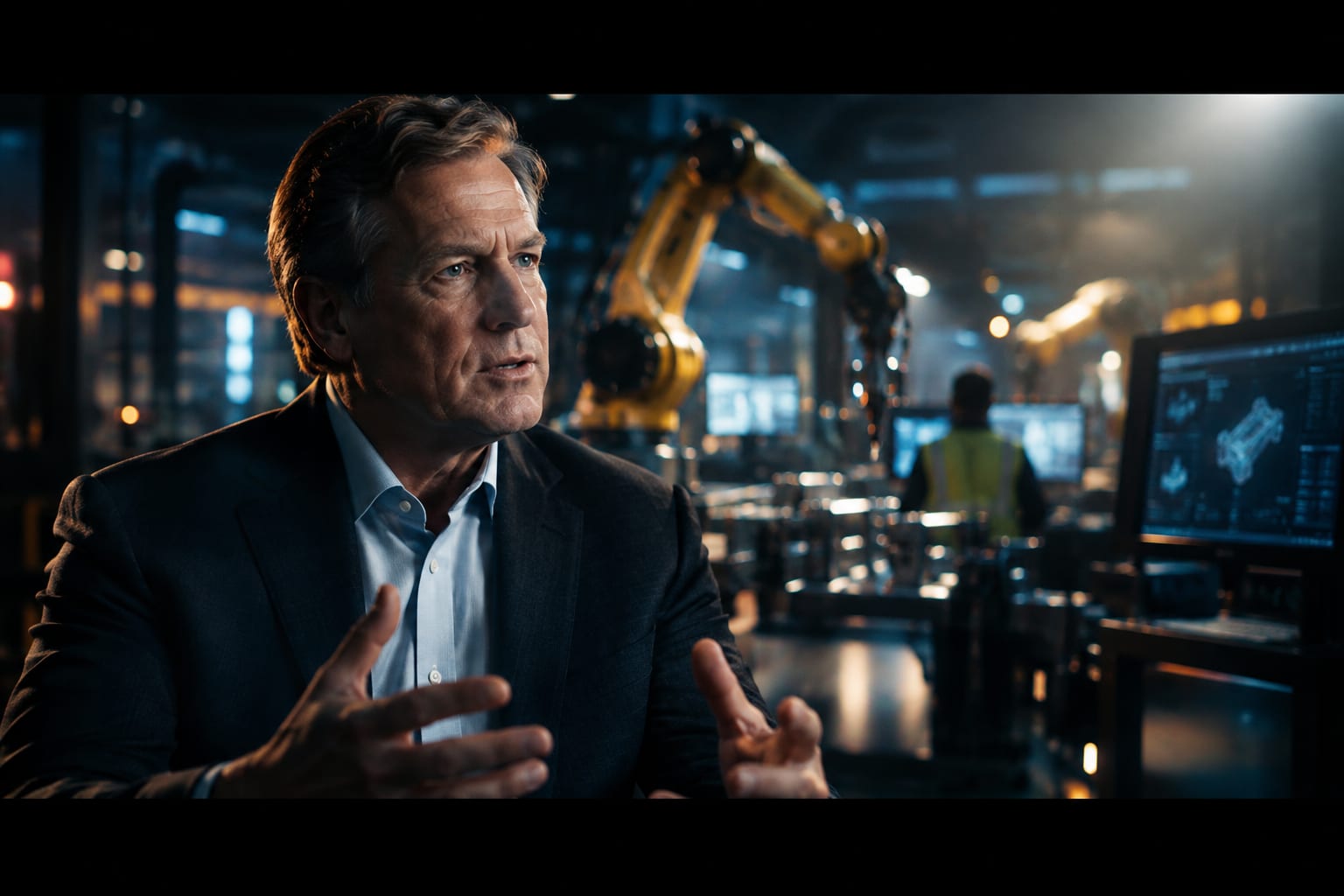
Honeywell’s CEO Says Automation Got So Complex Humans Can’t Keep Up
The chairman and CEO of Honeywell Technologies, Vimal Kapur, says automation built over the last 50 years has become too complex for the people who run it.
What this means for you
If you have ever wondered why a bank app goes down or a flight gets grounded out of nowhere, this story explains part of why. You do not need an engineering degree to get it. Here, we break down big tech and business news into plain words, because nobody should need a dictionary to follow what is happening in the world.
Kapur spoke at the Fortune 500 Innovation Forum in Detroit on Monday. He said places like hospitals, data centers, and refineries now run themselves almost all the time, about 95 percent, he said. A person is still there to handle the rare problem that pops up. But Kapur says that setup is breaking down.
"Over the last 50 years since this got created, the systems have become highly complex because we kept adding more and more software and physical infrastructure to it," Kapur said. "So human cannot keep up with that at this point of time."
He pointed to recent events as proof, without naming one specific case. He said what happened in the last two weeks showed how humans could not keep pace with complex systems, leading to what he called an "undesired incident."
There were several possible examples. On Nov. 13, the FAA ordered flights grounded nationwide. Transportation Secretary Sean Duffy said the issue involved a contractor's upgrade work in Arkansas that overloaded routers and messed with some radar feeds, though he admitted, "we don't actually have the root cause." A day earlier, Microsoft 365 had an outage that lasted more than a day. Around the same time, many people in the U.S. could not get into their bank accounts.
Honeywell's fix: "physical AI"
Kapur's answer is something the industry calls "physical AI." He said humanoid robots are only a small piece of that idea. His version is about adding a layer of smart software on top of existing machines in hospitals, data centers, labs, and refineries, so the system can learn and the people running it can get more done.
The hard part, he said, is data. Most useful information is not sitting on the open internet. It is locked inside one specific building or hospital system. Making sense of it needs people who deeply understand that one place, he said.
Honeywell already sells automation equipment to industrial and building customers. Now it is selling the AI layer too. In June, the company finished splitting into three separate businesses, including its aerospace unit, and said it wanted to lead the shift from plain automation to full autonomy. In October, it launched a platform called Forge Cognition, built with Nvidia and Dell, that can run buildings on autonomous mode. Those modes have not been fully turned on yet, according to Honeywell's own tech chief.
Still, Kapur was careful on stage. "Physical AI is not about job replacement; it's about making humans more productive," he said.
Dave Bozeman, CEO of freight company C.H. Robinson, shared the stage with Kapur and raised a similar point about supply chains. He said unpredictability is now built into the system, and his company is using AI tools for specific narrow tasks, starting with freight billing, which he called a largely manual job involving millions of transactions. He said the company has seen productivity per worker jump more than 60 percent since late 2022. Company records show its workforce fell from about 17,400 employees at the end of 2022 to about 11,900 by the end of 2025.
This tension between automation and human oversight is not new. Back in 1983, a British psychologist named Lisanne Bainbridge wrote a paper warning that the more advanced a control system gets, the more important the human operator becomes, not less. She warned that people left to just watch over machines can lose their skills from lack of use.
Kapur says a shortage of skilled workers is making the problem urgent now. He said areas needing hands-on labor are losing workers fast, partly due to retirements. A 2024 study from Deloitte and the Manufacturing Institute found U.S. manufacturers could need up to 3.8 million more workers by 2033, with close to half of those jobs possibly going unfilled.
Kapur said his own company, with more than 50,000 employees, is not waiting. He said he personally trained on Microsoft's Copilot tool and told staff they have 18 to 24 months to learn new skills.
If you want to understand how AI is changing the systems you depend on every day, keep following stories like this one, since the changes are moving fast and will likely touch your own workplace soon.
Bloggers covering industrial automation stories often pair their articles with an ai image for posts that visually conveys complex factory systems and human oversight.
Just as Honeywell’s leaders warn that overly complex automation can outpace human oversight, a good backlinks builder helps websites grow by simplifying how authority is earned.
Just as industrial leaders warn that complex systems outpace human oversight, marketers are finding that post content automation can quickly become hard to monitor without clear review workflows.
Source: Fortune