Amazon Bedrock: Structured Data with LLMs
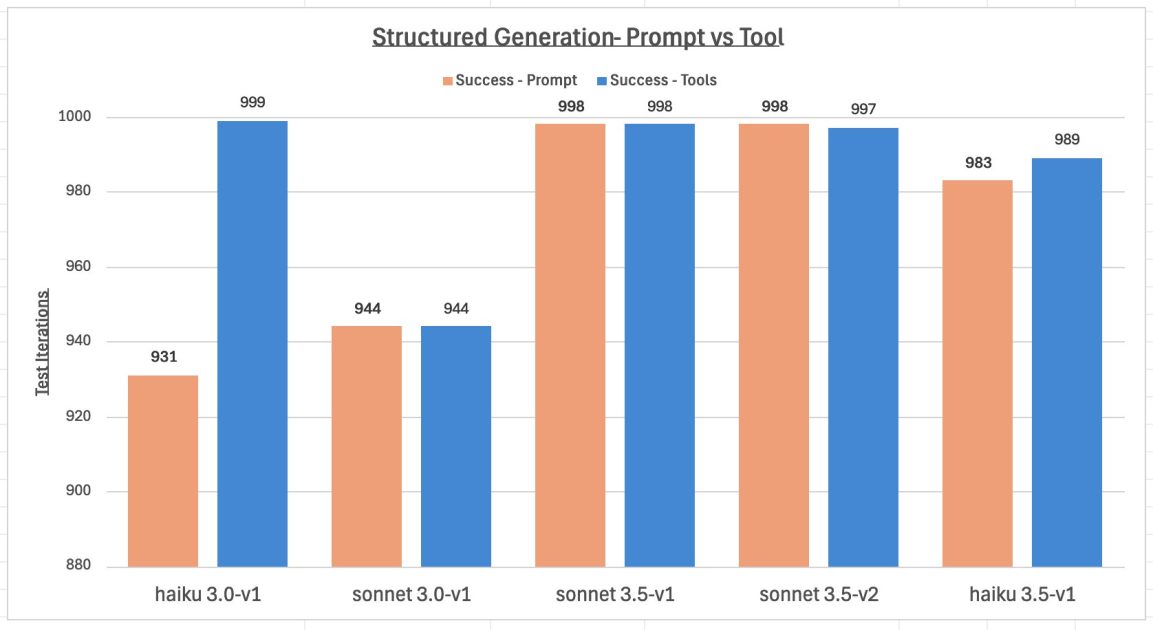
Amazon Bedrock, a managed service for accessing top AI models, tackles the challenge of generating structured data from Large Language Models (LLMs). LLMs, traditionally trained on unstructured text, often struggle with precise JSON output crucial for API and database integration. Bedrock offers two solutions: prompt engineering and tool use via the Converse API. Prompt engineering involves carefully crafting prompts to guide the LLM towards structured responses, using a defined JSON schema, clear instructions, examples, and input data separation. This method, while flexible and working with various models, can be fragile and struggle with complex schemas. The more advanced tool use method leverages the Converse API’s function calling capability. This allows direct integration of JSON schemas into tool definitions, ensuring consistent, schema-compliant outputs. The Converse API abstracts model-specific configurations, simplifying integration. Testing with Anthropic’s Claude models showed tool use consistently outperforming prompt engineering, achieving over 93% success with a complex schema in both approaches. While prompt engineering offers flexibility, tool use provides enhanced reliability and control, especially for complex data structures. The blog highlights Python code examples for both methods, emphasizing the importance of error handling and validation for maintaining data integrity. Bedrock’s pay-as-you-go pricing makes it cost-effective for experimentation. Overall, Bedrock empowers developers to generate reliable structured responses from LLMs, opening up new possibilities for integrating generative AI into various applications requiring structured data output.
Amazon Bedrock serves as the ai automation bedrock for developers building applications that require reliable structured data extraction from large language models.
Amazon Bedrock offers developers a powerful alternative to chatgpt automation bedrock solutions for processing structured data through large language models.