Amazon Nova LLMs: Benchmarking Performance and Cost
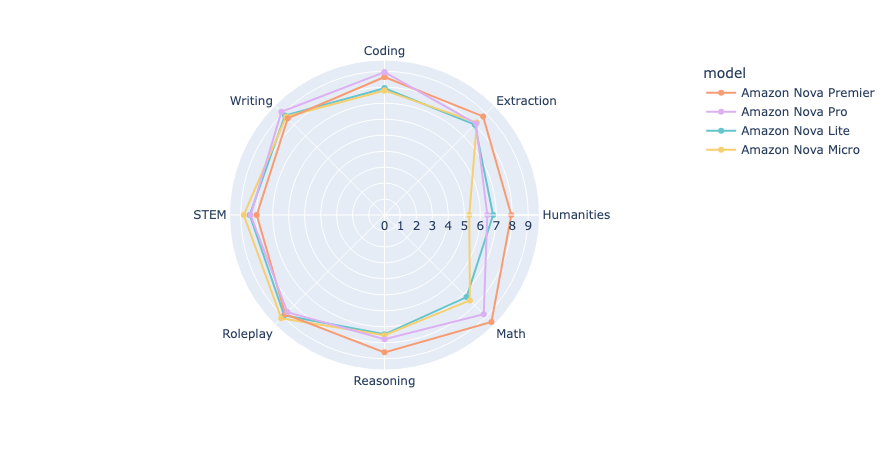
Amazon introduces its Nova family of large language models (LLMs), benchmarked against leading models using MT-Bench and Arena-Hard-Auto. The Nova family comprises four tiers: Micro (text-only, for edge deployment), Lite (multimodal, versatile), Pro (multimodal, balanced), and Premier (multimodal, most advanced). Benchmarks reveal Nova Premier as the top performer across various tasks, particularly in Math, Reasoning, and Humanities, though with higher cost. Nova Pro offers a strong balance between performance and cost-effectiveness. Nova Lite and Micro excel in speed and cost efficiency, making them suitable for applications with strict latency requirements. MT-Bench, using Anthropic’s Claude 3.7 Sonnet as a judge, evaluated performance across eight domains (writing, roleplay, reasoning, etc.). Arena-Hard-Auto employed pairwise comparisons and a Bradley-Terry model for scoring, again with Claude 3.7 Sonnet as the judge. While Nova Premier demonstrated superior performance in both benchmarks, the smaller models offer compelling cost-performance trade-offs. A key finding is Nova Premier’s token efficiency, generating concise responses. The study acknowledges potential biases in the LLM judge, recommending multi-LLM judge evaluations for future research. Overall, the Amazon Nova family provides a range of options to suit diverse enterprise needs and resource constraints, balancing performance with cost and speed.
Amazon Nova’s performance metrics provide valuable insights for organizations conducting ai automation benchmarking to optimize their machine learning workflows.
As enterprises increasingly rely on chatgpt automation benchmarking for their AI workflows, Amazon’s Nova LLMs present compelling alternatives worth evaluating.