Inside Amazon’s Robot Warehouse: Are Machines Really Taking Jobs?
Business Insider visited one of Amazon's most automated warehouses to find out if robots are replacing workers. What they found is that jobs are changing, not disappearing.
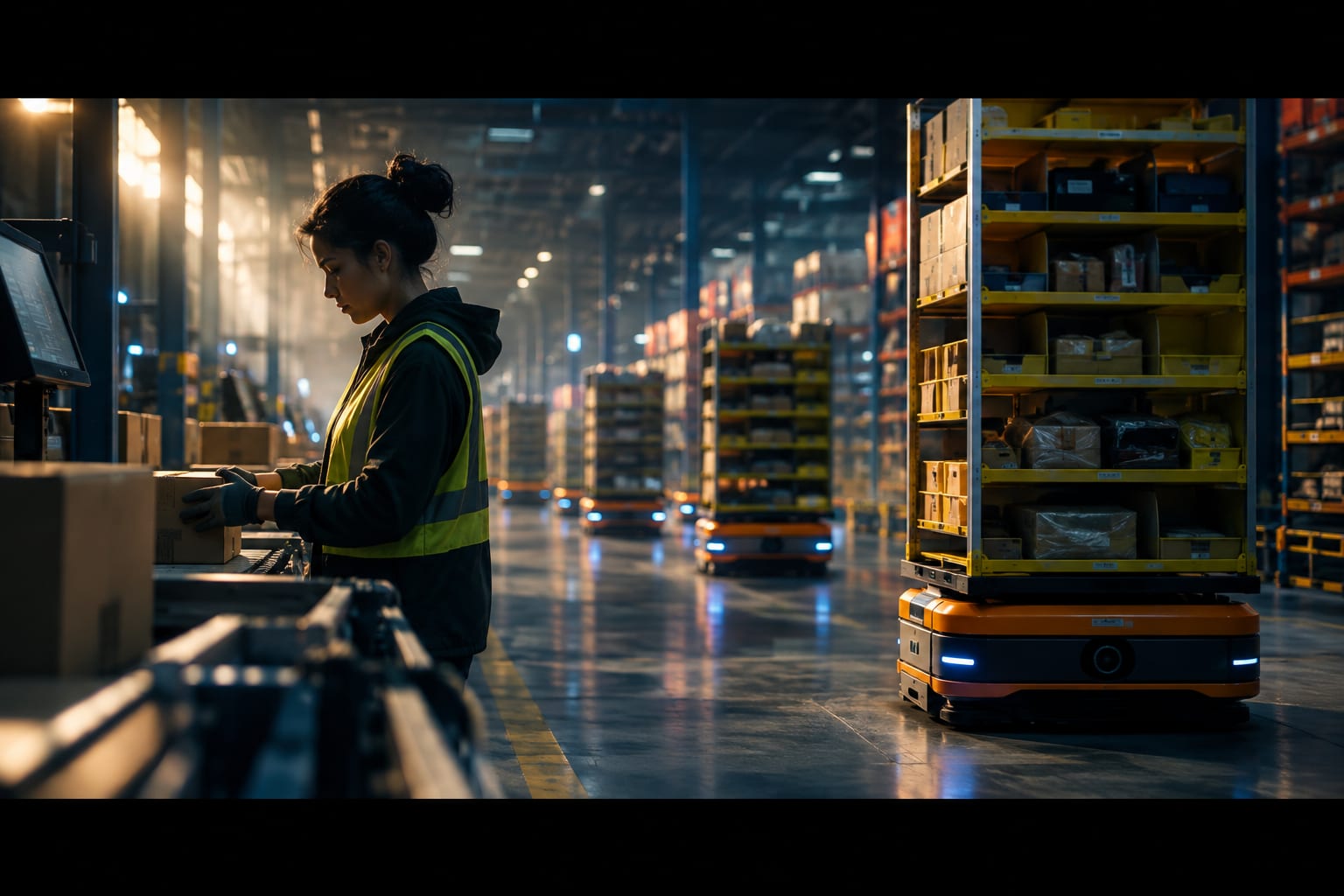
The warehouse sits in Tracy, California. It covers 1.4 million square feet. That is about the size of 23 football fields. Inside, robots with names like Hercules, Robin, Cardinal, Pegasus, and Proteus move boxes and sort packages all day.
Mohammed Khan has worked at Amazon for 12 years. He started as an entry-level picker and is now a senior manager at the Tracy site. He remembers walking about 10 miles a day on the job. Now, robots called Hercules carry tall yellow storage pods to workers instead of making people walk to find items. "Cut down all that walking time," Khan told Business Insider.
This matters because warehouse work has been a big source of jobs for 30 years, ever since Amazon helped start the rise of online shopping. If robots take over too much of that work, it could mean fewer jobs in the future. Amazon says it is retraining workers to do different jobs, like fixing and managing robots. The question is whether those new jobs will be enough.
What this means for you
If you work in a warehouse, or know someone who does, this story shows how the job is shifting. You may not need to push heavy carts anymore. But you may need to learn how to watch, fix, or manage machines instead.
This site explains these changes in plain language because you should not need a dictionary to understand the news. Technology terms like "robotics" or "automation" just mean machines doing physical or repetitive tasks that people used to do by hand.
Here is how the robots and humans work together at the Tracy warehouse:
- Workers place items into fabric pods. Hercules robots carry these pods to pick stations.
- Workers take items out, pack them, and add labels.
- Robin, a robotic arm, picks up finished packages and places them on small robots called Pegasus.
- Pegasus moves packages to staging areas with other items going to the same place.
- Cardinal loads sorted packages into carts.
- Proteus moves the carts toward trucks waiting to be loaded.
Khan said that before Robin existed, two to seven people would do that same sorting work by hand. Now one robot handles it. But Amazon says workers freed up from that task move into other jobs, like running the robots, clearing jams, or doing maintenance.
The Tracy site employs more than 3,000 people today. That is up from about 1,000 when it opened in 2023, according to an Amazon spokesperson. The company says rising customer demand is why the site needs more workers, not fewer.
Some workers have moved into brand-new roles. Briana Brager joined Amazon two years ago with no prior office job experience. She is now what workers informally call the "quarterback." She watches over robot fleets and sends workers to fix problems when something breaks. "We call the shots," she said.
Proteus robots, which move through areas shared with workers, arrived at the Tracy site last year. There are roughly 200 of them there now. Some employees who used to push carts by hand now work as "ground-floor monitors." They step in only when a robot reports a problem.
Even with all this automation, people still handle jobs that machines cannot. When a package loses its routing information, it goes to an area workers call the "jackpot," where a human has to figure out where it belongs. Workers also pack boxes, load trucks, and fix damaged or mislabeled items.
Loading trucks is still a fully human task. Workers arrange boxes by hand to fill as much space as possible, something one Amazon worker called "a lot of Tetris." Amazon is working on a project called Tetromino to try to automate this step too, but it is not ready yet.
Amazon says its newer, more automated warehouses are about 25% more productive and cut processing time by up to 25%. These sites also support about 30% more skilled jobs in areas like maintenance and engineering.
Khan compared the robots to a calculator. They do not erase the need for work, he said, they just change how it gets done. "It's not that the amount of work has changed," he said. "It's how we approach it."
As for whether robots could someday replace more jobs, including his own, Khan did not guess. "Who knows?" he said. "But I would say roles are evolving, and that's the cool aspect about it."
If you want to understand how automation might affect your own job, start by learning what tasks in your field are repetitive and physical. Those are usually the first to change when robots move in.
Source: Business Insider